The Hidden Cost of Publishing: Why the Transition to Open Access Did Not Make Science Cheaper for Latin American Universities
Keywords:
Article Processing Charges, Scholarly communication, Latin America, Universities, Publishing costs, Scientific publishing, Open accessAbstract
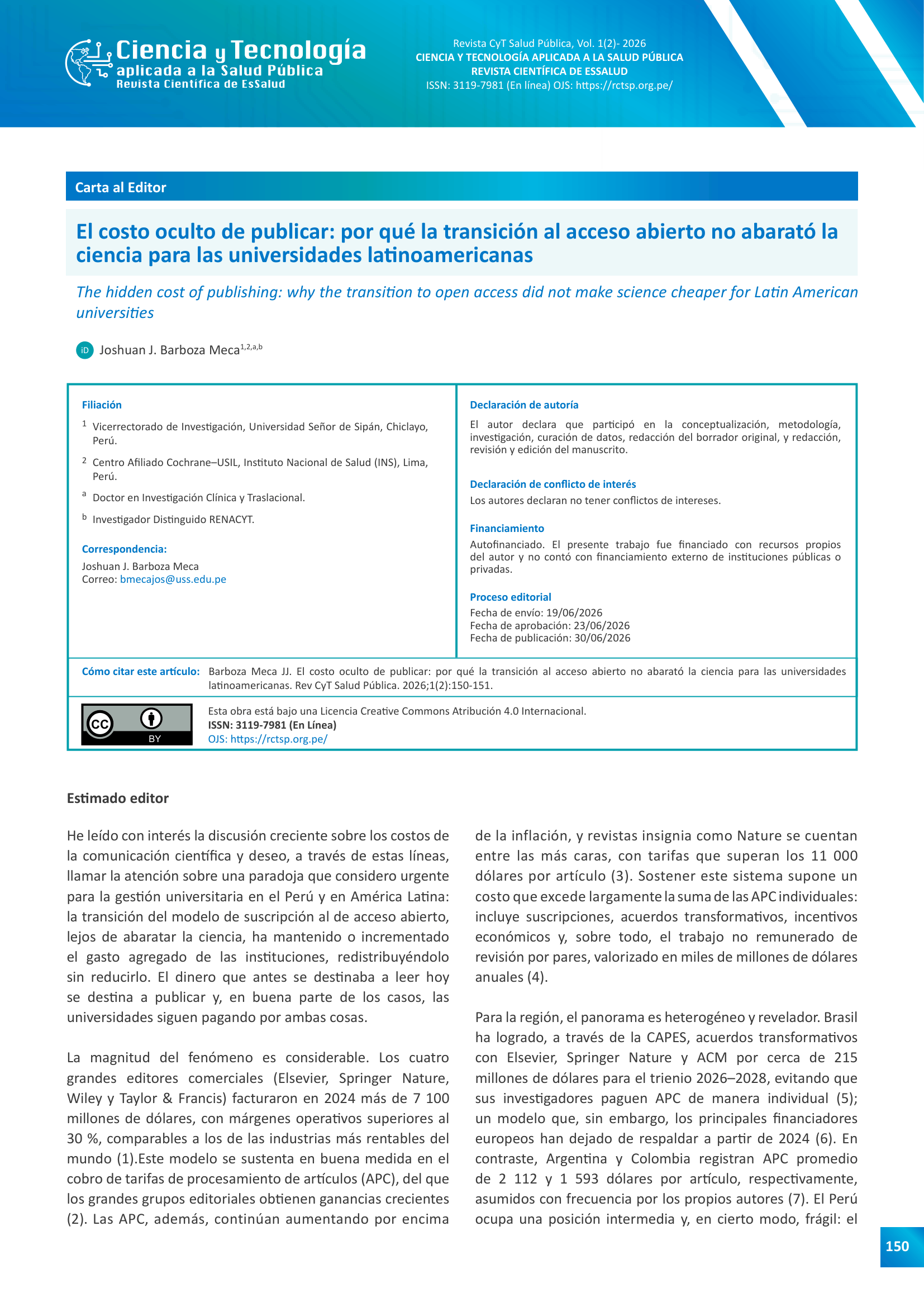
Introduction: The transition from subscription-based publishing to open access has transformed the scientific communication landscape. However, this shift has not reduced overall publishing costs for Latin American universities but has instead redistributed expenditures toward article processing charges (APCs), transformative agreements, and institutional incentives.
Objective: To discuss the economic impact of the open access publishing model on Latin American universities, particularly in Peru, and to propose strategies to improve the financial sustainability of scholarly communication.
Content: Recent evidence regarding the concentration of the academic publishing market, the continuous increase in APCs, transformative publishing agreements, and national research funding policies is examined. The article also discusses the influence of institutional incentives on scientific productivity and highlights the need for responsible research assessment frameworks that emphasize research quality rather than publication volume.
Conclusions: The true cost of scientific publishing remains largely underestimated within higher education institutions. Developing institutional cost-monitoring systems, promoting collective negotiations with publishers, strengthening diamond open access infrastructures, and adopting responsible research assessment models are essential strategies to ensure sustainable and equitable scholarly communication across Latin America.
Downloads
References
1. Beigel F, Brockington D, Crosetto P, et al. The drain of scientific publishing. arXiv. Publicado el 6 de noviembre de 2025. doi:10.48550/arXiv.2511.04820.
2. Butler LA, Matthias L, Simard MA, Mongeon P, Haustein S. The oligopoly's shift to open access: how the big five academic publishers profit from article processing charges. Quantitative Science Studies. 2023;4(4):778-799. doi:10.1162/qss_a_00272.
3. Springer Nature. Article Processing Charges (APC). Consultado el 23 de junio de 2026.
4. Aczel B, Szaszi B, Holcombe AO. A billion-dollar donation: estimating the cost of researchers' time spent on peer review. Research Integrity and Peer Review. 2021;6(1):14. doi:10.1186/s41073-021-00118-2.
5. Coordenação de Aperfeiçoamento de Pessoal de Nível Superior (CAPES). Acordos transformativos com ACM, Elsevier e Springer Nature (2026–2028). Portal de Periódicos da CAPES. Consultado el 23 de junio de 2026.
6. cOAlition S. cOAlition S confirms the end of its financial support for Open Access publishing under transformative arrangements after 2024. Plan S. 26 de enero de 2023.
7. Soto-Herrera DA, Beigel F, Pallares C. Costos de publicación en acceso abierto bajo el modelo APC: Argentina y Colombia. Revista Interamericana de Bibliotecología. 2025;48(1):e357790. doi:10.17533/udea.rib.v48n1e357790.
8. Consejo Nacional de Ciencia, Tecnología e Innovación Tecnológica (CONCYTEC). Acceso a bases de datos científicas para universidades peruanas. Consultado el 23 de junio de 2026.
9. Perú. Decreto Supremo N.° 028-2026-EF. Establecen los montos, criterios y condiciones de la Bonificación Especial para el Docente Investigador en universidades públicas. Diario Oficial El Peruano. 2026.
Downloads
Published
Issue
Section
License
Copyright (c) 2026 Joshuan J. Barboza Meca (Author)

This work is licensed under a Creative Commons Attribution 4.0 International License.